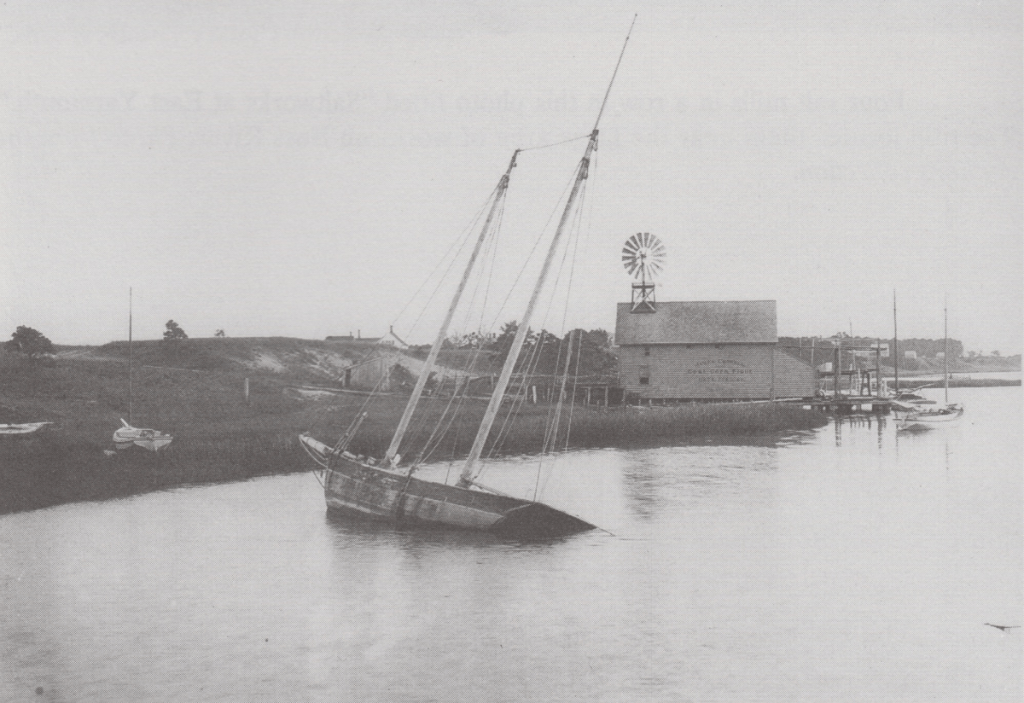
Here’s a great picture of the schooner “Annie Louise” moored at Crowell’s coal dock in West Dennis, sometime between 1891 and 1900. The picture comes from the Dennis Historical Society web site, which dates it about 1893. The bridge behind her was built in 1891 (Muse, 2014), and, as explained below, she stopped coming to West Dennis in 1900.
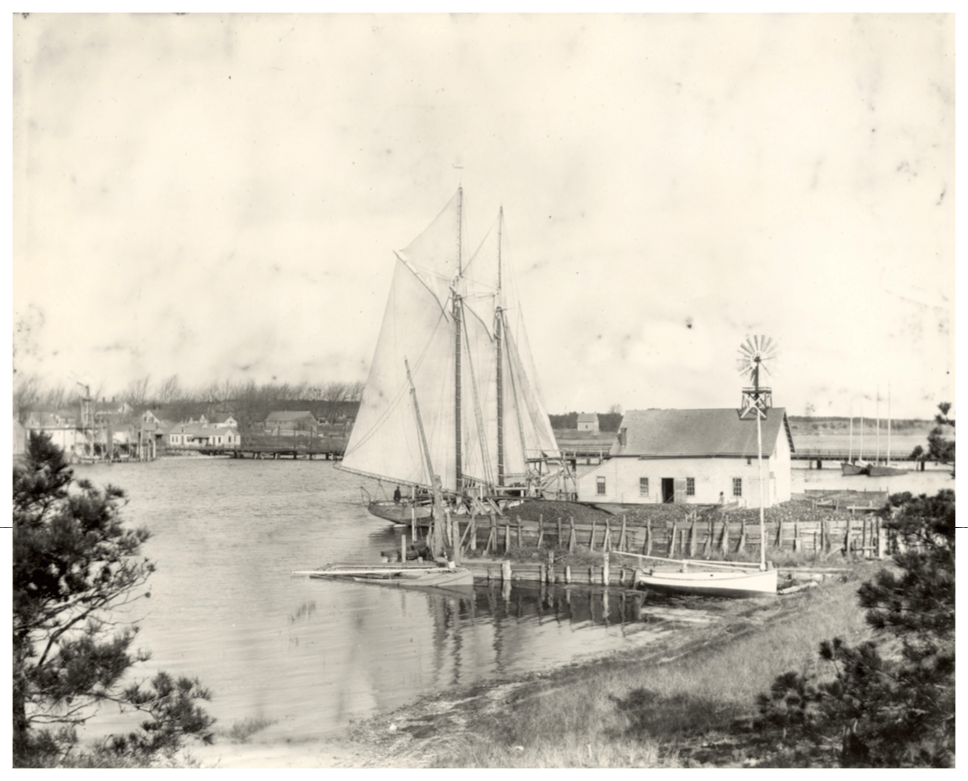
The Annie Louise was built in Kennebunk, Maine, in 1882 for Captain James Crowell of West Dennis, and his partners. She had a retractable (or center-board) keel to make it easier to sail in shallow coastal waters like Bass River. Her overall keel length was 62 feet, she was 22 feet across, and the paper described her as “shoal, sharp and sightly, built of the best stock in a thorough manner…” (BP, 1882a)
Crowell was a sailor with 40 voyages to the West Indies under his belt when he retired from the sea in 1880, and began to operate a corn and coal business in West Dennis. (Muse; BP 1898)
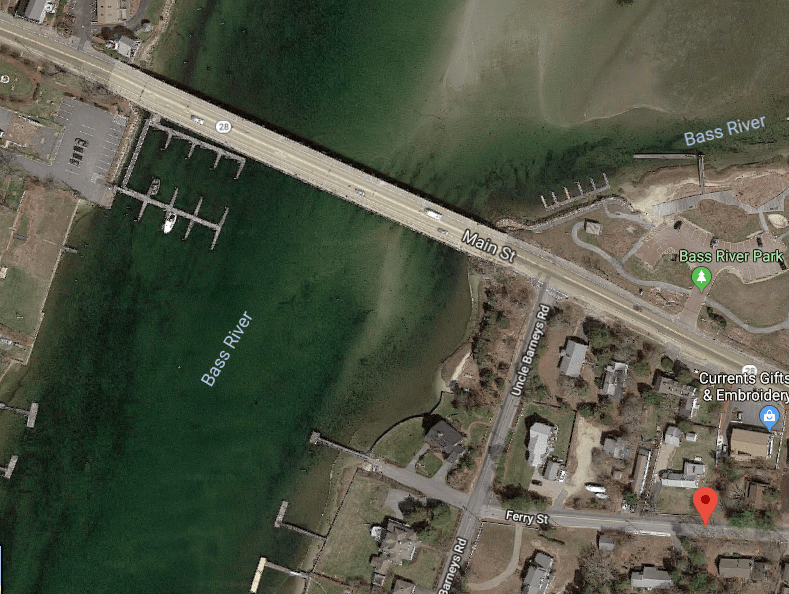
His dock and coal yard stood on the east side of Bass River, about 200 feet south of the bridge between South Yarmouth and West Dennis, at the foot of today’s “Ferry St.” I’ve included maps of the area in 1880 and about 2017, later in these notes.
Crowell built the Annie Louise to bring coal from New York to Bass River for his business. She also carried other cargos and passengers to and from New York, or other ports, as opportunities rose. She was named for his two daughters. (BP 1882b)
Although early stories about the business focus on coal and corn, his business actually advertised a large variety of bulk products. An ad from the 1890s says, “James Crowell, wholesale and retail dealer in all kinds of coal, wood, in any form or quantity, corn, flour, cracked corn, meal, oil meal, oats, feed, &c.” His wharf and mill stood on Mill Street near the Bass River Bridge in West Dennis. (Anon)
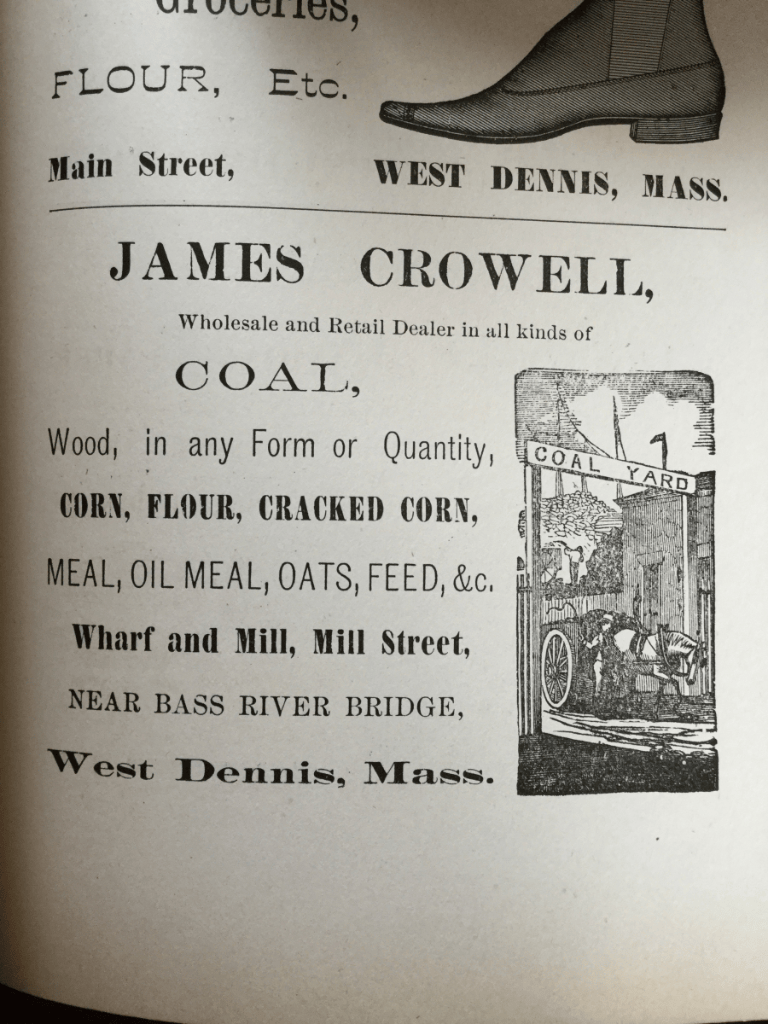
The presence of a mill for grinding grain explains the windmill sitting above the roof of the warehouse. It would be interesting to know more about the milling operation and how the machinery worked.
The reference to Mill Street is interesting. The street is now called Ferry Street, referring to a ferry that operated between the location of the wharf and the South Yarmouth side of the river in the late 18th and early 19th centuries. This ferry went out of business in the early 1830s when the first bridge was built across the river.
From about 1810 to 1863, a more traditional looking windmill once stood on this road, on the hillside above Crowell’s wharf. That mill was sold and moved to South Yarmouth where it still stands next to the lower river. (Reid) That mill and its machinery are in remarkable condition and can be toured during the summer.
Getting back to the Annie Louise, Morris Cole of South Yarmouth, a part owner, was to be her skipper. Cole would be associated with the Annie Louise for many years; he’s identified as her skipper in a news story as late as 1897. (BP, 1882) I imagine Captain Crowell would also pitch in as needed. As described later in the notes, a third man, Coleman Nickerson Thacher, also skippered the Annie Louise for the firm, at least in the late 1890s.
In December, 1881, Crowell was in New York negotiating to buy a schooner (BP, 1881). He had the Annie Louise at work by early-June 1882, when the Barnstable Patriot reported that the new packet, which was “just launched”, had sailed from Bass River for Harding’s Beach in Chatham “for a load of fish for down east.” (BP 1882b)
Thereafter, the Barnstable Patriot records her continually passing back and forth, between Bass River and New York. From one story it looks like a four day and seven hour (103 hours) round trip between Bass River and New York was considered a good time – although her competitor across the river, the “David K. Akin”, is said to have made the round trip once in 72 hours, and the Annie Louise herself is reported to have made the trip in 74 hours. (BP 1893; BP 1897)
Adventure periodically interrupted the working routine. In 1887 she broke from her moorings off Bass River during an early April storm, with no one aboard. She drifted out into the Atlantic and was eventually salvaged by the schooner Conductor “sixty miles south-east by south from Highland Light.” Capt. Crowell paid $950 in salvage fees to get her back, and he was lucky to be able to do it. By late April she was back on the New York run. (BP, 1887)
In 1893, both she and the similarly sized South Yarmouth packet “David K. Akin” were caught off Bass River by storm winds from the south. Their crews had to cut them free from their anchors and make for the entrance to Bass River. Both got in, and were driven up the river like racers by the wind. The Annie Louise reached home safely, but the Akin crashed into the Bass River bridge. (Muse, 2014b)
I imagine there were other adventures and dangers that we don’t have records for. But mainly she was a hard working packet and coaster moving people and cargos back and forth along the coast.
Late in the 1890s Coleman Nickerson Thacher turns up as a skipper. Thacher’s dad was a West Dennis businessman, operating as a wheelwright, and later adding undertaking and painting supplies to his business. Coleman stepped in and took over his dad’s businesses when his dad died. In 1883 Thacher married James Crowell’s daughter Annie, uniting these two West Dennis business families. (Muse, 2014a)
The story, to the extent I have it, comes to an end in the years 1898 to 1900.
Captain Crowell died in 1898. From his obituary, it sounds like he was working in his office at the coal yard just before noon on a Friday, when he may have had a stroke. He was taken home and lost consciousness in the afternoon. He never came to, and died the following Monday. (BP, 1989)
In October 1900, the Annie Louise herself was rammed amidships by a sloop while at anchor in New Haven’s harbor. Captain Thacher and his crew escaped with their lives, but the vessel sank within 10 minutes, and their possessions were lost. She appears to have been carrying a cargo of soft coal for the American Metallic Company of South Yarmouth. (BP, 1900a, b, c)
She was raised by a wrecking company from New York, presumably at the expense of the owner of the sloop that struck her. By mid-December she had been sold to New Haven interests. (BP, 1900a, b, c) I don’t know her ultimate fate.
Tying up two more loose ends: Coleman Thatcher and Morris Cole both died in 1901. (Muse, 2014a; BP 1901)
Of course this is not the end of the story of the coal wharf. Who inherited the Crowell and Thacher estates. Did the widows attempt to carry on the coal operation for a while? Were the assets sold to someone else who tried to carry it on? What about the people in West Dennis who needed coal? What eventually happened to the business, the wharf and the warehouse?
There are questions here to take to probate records and the Dennis Historical Society collection next time I’m down. Advertising directories from the early 20th Century, for example, may show Crowell’s business operating after Thacher’s death in 1901.
Coastal coal shipments in the late 19th Century
Lots of vessels were active moving coal along the coast in the late 19th Century. My impression, and its not more than that, is that wholesale and retail sales of coal got off the ground on the Cape in mid-century.
I’ve heard that the first cargo of coal delivered at Hyannis, 30 tons, came in the 1840s. (BP, 1905) A first attempt to establish a coal business on Bass River, in 1850, was not a success. (Muse, 2014d).
Pauline Derick, in notes held by the Dennis Historical Society, says that in the 1860s Captain Coleman Nickerson dealt in coal and wood from a wharf just south of the Bass River lower bridge. I assume this is on the West Dennis side of the river, although Derick doesn’t explicitly say.
If so, that may explain an odd feature of the 1880 map at the end of these notes. This shows a coal wharf at the site. But the map, published in 1880, probably reflected activity in 1878 or 1879, when the data must have been collected. So it may be that Captain Crowell took over an ongoing business.
I’ll also note the similarities between between the names Coleman Nickerson, and Coleman Nickerson Thacher. My best conjecture right now is that Thacher’s grandfather, his mother’s father, was Coleman Nickerson, the owner of the coal wharf in the 1860s. This needs more research.
Captains Loring Fuller and Hiram Loring started a grain and coal business on the South Yarmouth side of the bridge in 1866. They operated two schooners over the years: first, the S.K. Lane, and then, from 1882 until about 1912, the David K. Akin. This business was still going in 1914, although by then the firm depended on rail for coal and grain deliveries. (HP, 1914)
I’m not sure that the vessels loaded coal in New York itself. I think is it more likely that they loaded on the New Jersey side of the Hudson River at a railroad terminus adapted for transferring coal from railroad cars to vessels. (W.C.R., 1907)
I have a vague recollection of a coal bunker at the lumber yard by the railroad in South Dennis in the 1960s. The railroad reached South Dennis about the end of the Civil War, so it’s interesting that Crowell’s coal yard, depending on coastal schooner deliveries, was competitive with the railroad for many years after that.
The picture that heads up these notes is so detailed, I think you can distinguish between three grades of coal in different piles alongside Crowell’s warehouse. The finest grade is closest to the dock, the coarsest grade is furthest from it. It looks like a ramp – maybe for wheelbarrows to move the coal from the Annie Louise – is built above the piles.
Anchor draggers
The Annie Louise lost her anchor off Bass River at least twice in the story above. Vessels were constantly losing their anchors offshore, and a service industry, anchor dragging, sprang up in response.
Anchor dragging involved a pair of small schooners dragging a rope between them along the seabed in order to snag lost anchors.
In the photo of the Annie Louise at the start of this note, on the left side, in the middle distance, between the coal dock and the bridge, there are two small schooners anchored together. I assume these are the two vessels in the photo just below; I’ve heard that these two vessels are anchor draggers.
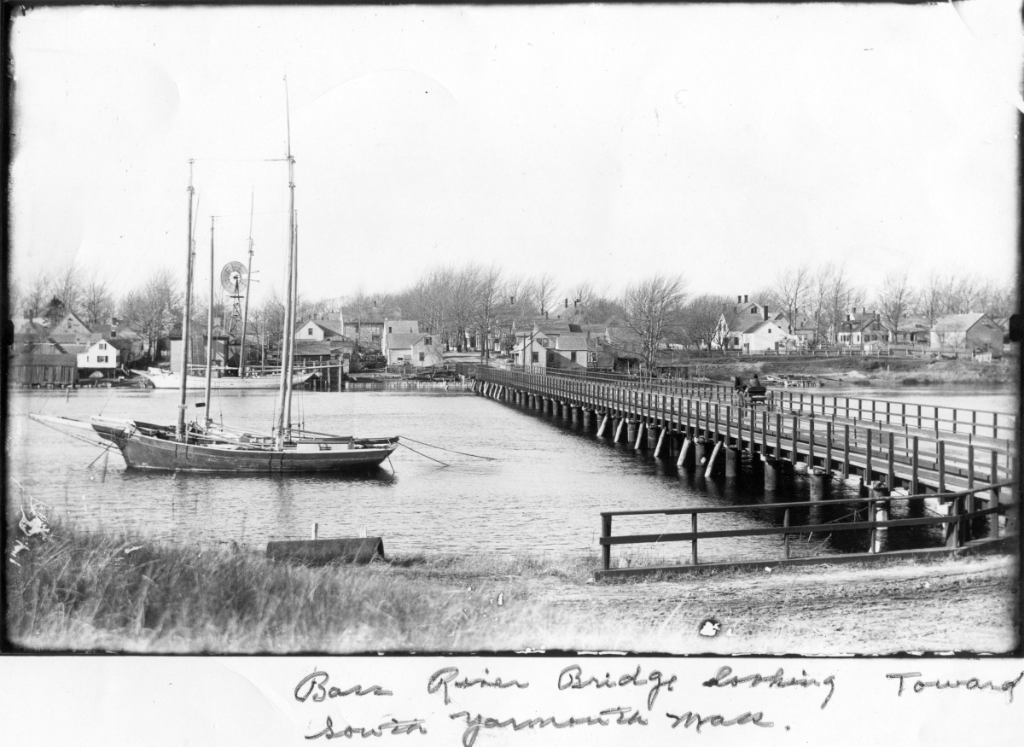
While both photos seem to have been taken at the same season, given the bare trees in the background, they don’t appear to have been taken at the same time. This photo shows a large schooner docked across the river, on the Yarmouth side. That’s the David K. Akin, the packet and cargo vessel operated by the Loring and Fuller coal and grain business on the Yarmouth side of the river. She’s tied up at the firm’s wharf and warehouse. She’s missing in the photo of the Annie Louise that opens these notes.
Another photo on the DHS website shows these two anchor draggers, with one moored to the bridge, which is being used as a platform to do some sort of maintenance, or to load or unload equipment. That photo shows the stern of one of the vessels, which appears to be called the “Mary Emma.” An anchor dragger called the Mary Emma operated from Bass River in tandem with a second dragger called the “Addie Watts.” These are probably those two draggers. (Muse, 2014b)
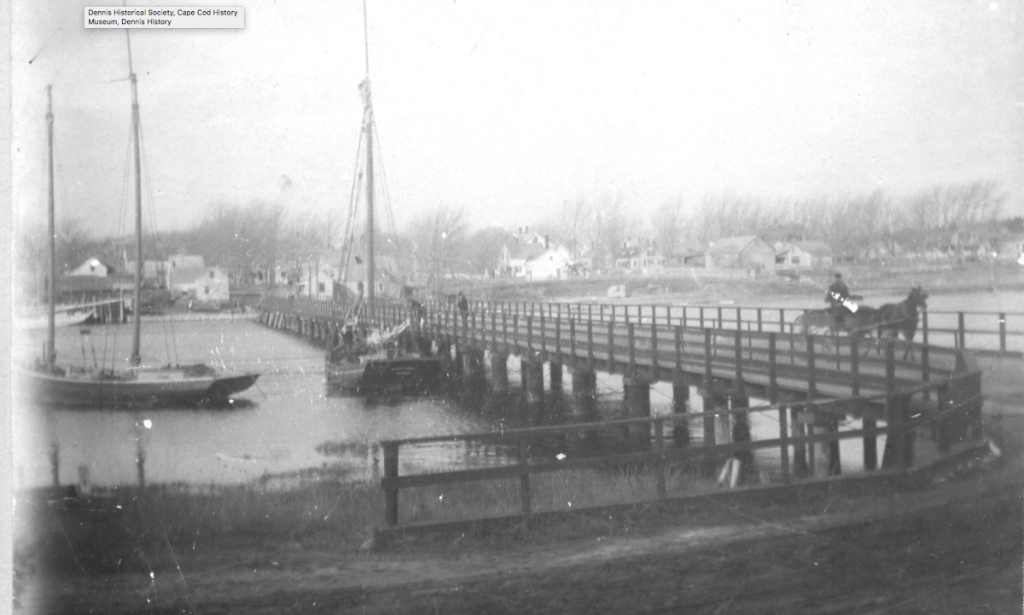
It looks like one of these two anchor draggers has recently been abandoned in the photo below. This photo looks from the bridge (about where the buggy in the last photo) south towards the coal dock (copied from Quinn’s book on the salt works of Cape Cod). She still has rigging in place.
Maps showing the location of the Crowell coal dock, and the locations of the photographers
As I said, the pictures were taken along the West Dennis shore of Bass River, just south of the bridge between South Yarmouth and West Dennis. The maps below show this more clearly. One is from 1880 and the other is a recent Google satellite view.
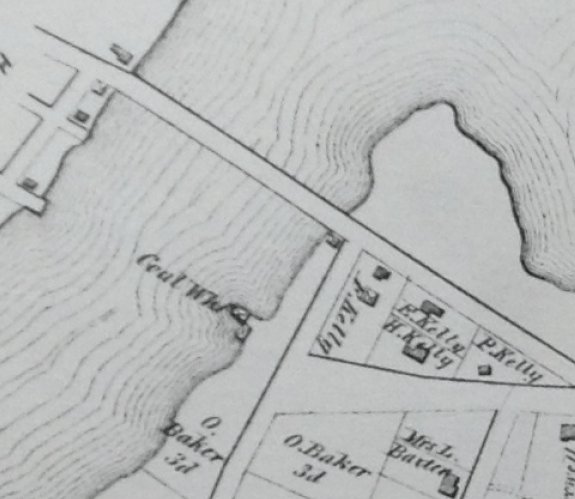
Before the 1830s, the location where the coal dock is shown was the Dennis terminus for a ferry that ran across the river to South Yarmouth. This use of the property ended when the first bridge was built in the early 1830s.
It looks to me like the area where the warehouse and wharf were has been filled in somewhat since 1880 so that I think the current wharf (the first south of the bridge) extends out further than the coal wharf did.
References
Anon. The first Resident Directory of Dennis, Mass. Containing also Business, Street and Social Directories. J.H. Hogan Company. Quincy, MA. 1895.
Barnstable Patriot back issues accessed through the Sturgis Library online archive (Accessed at http://digital.olivesoftware.com/Olive/APA/Sturgis/default.aspx#panel=home in March 2018.)
Barnstable Patriot. 1881. December 13, 1881, page 5.
Barnstable Patriot. 1882a. May 16, 1882, page 2.
Barnstable Patriot. 1882b. June 13, 1882, page 3.
Barnstable Patriot. 1887. April 12, 1887, page 2.
Barnstable Patriot. 1893. May 9, 1893, page 3.
Barnstable Patriot. 1895. September 9, 1895, page 5.
Barnstable Patriot. 1897. June 7, 1897, page 3.
Barnstable Patriot. 1898. October 31, 1898, page 3.
Barnstable Patriot. 1900a. October 14, 1900, page 3.
Barnstable Patriot. 1900b. December 9, 1900, page 3.
Barnstable Patriot. 1900c. December 10, 1900, page 3.
Barnstable Patriot. 1901. July 15, 1901, page 4.
Barnstable Patriot. 1905. November 2, 1905, page 3.
Dennis Historical Society. Photo, “Bass River bridge”. Accessed at http://archive.dennishistsoc.org/handle/10766/12366 on March 16, 2018. Shows bridge and two anchor draggers looking west towards South Yarmouth from West Dennis abutment.
Dennis Historical Society. Photo, “Bass River Bridge”. Accessed at http://archive.dennishistsoc.org/handle/10766/9360 on March 16, 2018. Shows bridge and two anchor draggers, one moored to bridge. Looking west towards South Yarmouth from road approaching the bridge from the south.
Dennis Historical Society. Photo, “Bass River ca 1893”. Accessed at http://archive.dennishistsoc.org/handle/10766/15404 on March 16, 2018. Looking north along West Dennis shore of Bass River towards Crowell’s coal dock and the Annie Louise.
Derick, Pauline. Notes in the possession of the Dennis Historical Society.
Google maps.
Hyannis Patriot. 1914. “Remarkable Record.” April 20, 2014, page 3.
Muse, Ben. 2014a. “One-stop shopping.” Bass River Notebook. Posted on March 4, 2014. Accessed at http://benmuse.typepad.com/bassriver/2014/03/groceries-and-undertaking-supplies.html on March 10, 2018.
Muse, Ben. 2014b. “Anchor dragging.” Bass River Notebook. Blog. Posted May 1, 2014. Accessed at http://benmuse.typepad.com/bassriver/2014/05/anchor-dragging.html#more on March 8, 2018.
Muse, Ben. 2014c. “The lower bridge, before and after 1914.” Bass River Notebook. Posted September 1, 2014. Accessed at http://benmuse.typepad.com/bassriver/2014/09/my-entry.html on March 10, 2018.
Muse, Ben. 2014d. “Levi Crowell Jr.’s short-lived coal, wood, and lumber business.” Bass River Notebook. Posted November 3, 2014. Accessed at http://benmuse.typepad.com/bassriver/2014/11/coal-and-grain.html on March 10, 2018.
Quinn, William P. The Saltworks of Historic Cape Cod. A Record of the Nineteenth Century Economic Boom in Barnstable County. Parnassus Imprints. Orleans, MA. 1993.
Reid, Nancy Thacher. Dennis, Cape Cod. From Firstcomers to Newcomers 1639-1993. Dennis Historical Society. Dennis, MA. 1996.
W.C.R. 1907. “The Coal Pier at Port Liberty.” The Coal and Coal Trade Journal. Volume 46, page 887. Coal Publishing Corporation. 1907. Accessed at https://books.google.com/books?id=kn4-AQAAMAAJ&pg=PA887&lpg=PA887&dq=%22Port+Liberty%22+%26+coal&source=bl&ots=6n9GzLI-9-&sig=jnvKoPR2SLVYNZacciO8B0RJE6U&hl=en&sa=X&ved=0ahUKEwi7nsODyNTZAhUDS2MKHR8IDXkQ6AEIKTAA#v=onepage&q=%22Port%20Liberty%22%20%26%20coal&f=false on March 4, 2018.
Leave a Reply