Not long ago, I bought an advertising card for a 19th Century West Dennis businesswoman, Mary E. Kelley.
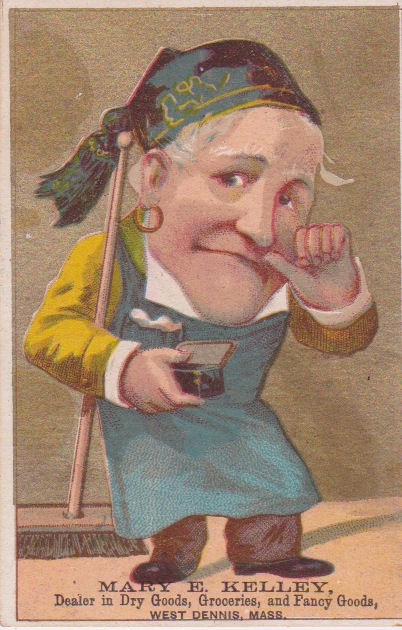
The card shows an old sailor (white hair, ring in ear), retired from the sea and working as a clerk in a store (apron, broom). I like his Victorian fez and tassel! He’s stopped sweeping for a moment to take a pinch of snuff.
Mary evidently had a sense of humor, and a sense of place. Men like this must have been common in 19th Century Cape businesses. Mary was selling groceries, fabrics (dry goods), and decorative odds and ends for dress or house decoration (fancy goods).
Who was Mary Kelley, where did she come from, where did she go, how did she happen to have a store in West Dennis? Is it possible to date the card? How much is it possible to learn about a 19th Century Dennis resident who wasn’t actually a ship captain?
This is a progress report on ongoing research. There is a lot of conjecture here, but this blog is a “Bass River Notebook”, not a polished “History of Bass River.”
It turns out that a Mary E. Kelley had a store in West Dennis, first with her husband, and then by herself, in the 1870s and early 1880s.
Young Mary Gage
Mary was born Mary Edwards Gage, on September 25, 1852. Her parents were Zeno and Sarah Gage of South Dennis. (Dennis Vital Records, Vol 1, page 285) Zeno and Sarah were in their late ‘30s, and already had five other living children – all boys. Two of the Gage’s children, including their only other daughter, had already died. Zeno is described as a master mariner in the 1855 state census. (Dennis Vital Records, Vol 1, page 285; 1855 Massachusetts’ census)
The 1858 Atlas of Barnstable County shows the home of a “Z Gage” about 500 feet south of Grand Cove, right about where the South Dennis Main Street forks off from what is now Route 28. The 1880 Atlas has a house labeled “Z Gage” in about the same spot. The 1880 Atlas also shows homes that likely belonged to three of her brothers (Rufus, Zeno Thatcher (“T”) and Freeman (“F”) Gage) along the stretch of road between “Z Gage” and the Congregational Church). In 1882, Lucius Gage would buy his brother Thatcher’s house, so that puts another of the five brothers right in this neighborhood (Patriot, September 26, 1882). The commercial center at West Dennis was a 10 to 15 minute walk west along the sandy road.
Until I find letters or diaries I won’t have any details about Mary as a young girl or teenager. She must have played with her younger brothers and neighbors, had her particular girl friends, helped with chores around the house, and gone to school. I don’t know what inferences we can make knowing that she was both the only surviving girl, and the youngest child. Mary would have been eight when the Civil War began, and twelve when it ended. The train came to Dennis in 1865, when she was twelve.
At some point, boys entered the picture. Some would have needed fending off, some would have been agreeable company, and some would have been attractive but unapproachable. Finally, one evidently stood out. Mary began 1870 as a 17-year old schoolgirl, the only child left in her parents’ household; she ended 1870 as a married 18-year-old.
Mary Kelley: a merchant of Dennis
On November 19, Mary married Wilber K. Kelley, also of South Dennis, in Portsmouth, New Hampshire. (Patriot, 12/19/1870) Wilber Kelley had been born in September 1848, and was about 4 years older than Mary (Wilber K. Kelley headstone, Swan Lake Cemetery, Dennisport).
I don’t know how they supported themselves from late 1870 to 1875, but in early 1875,Wilber bought the inventory of a store in West Dennis. Mary’s older brother, Zeno Thacher Gage, had worked in Taunton for a few years and, using the capital accumulated there, had taken over an existing grocery and dry goods store in West Dennis in early 1874. (Patriot, April 21, 1874) In early 1875, Thacher sold the inventory to Wilber. (Patriot, March 2, 1875) By June 1875 the Patriot refers to “W.K. Kelley” as “our popular storekeeper.”
Did Wilber and Mary enter the business under Thacher’s auspices, as employees or partners, and gradually take over the business? How did they finance the purchase? Why did Thacher sell his store only a year after starting it? Deyo, who describes several businesses in West Dennis, traces the ownership of the business and finds Z.T. Gage (our Zeno Thacher?), William Kelley (our Wilber?), Mary E. Gage (our Mary Kelley), and Calvin F. Baker, as successive owners. Deyo says Mary Gage sold to Baker in 1883. (Deyo, page 532) We’ll come back to this.
Stories in the Patriot in June and September 1875 explain that Mary had recently been to Boston to select summer and fall goods. Mary “knows just what will suit her friends.” (Patriot, 6/8/1875, 7/14/1875) Mary would have been 22 or 23 at the time. Presumably these are dry goods or fancy goods that would appeal to young women. The 1880 census lists both Mary, and Wilber, as grocers.
Before 1832, the West Dennis area had been thought of as a part of South Dennis, and the commercial center we know now wasn’t there. People lived in this area, and there was commercial activity; in the early 1830s, Levi Crowell and his wife had operated a store on Church Street that attracted customers from other towns. The commercial center grew after the bridge to South Yarmouth was built in 1832. A West Dennis post office was opened in 1833, and a Methodist church was built in 1835. (Reid; Perry) By the 1870s, West Dennis was a busy place.
One Saturday in 1877, a writer for a Harwich paper walked down the main street in West Dennis and saw stores for groceries, dry goods, tin products, furniture, boots and shoes, clothes and dresses, harness, tombstones, and grain. The story lists 13 businesses within a few hundred feet of the Kelley’s store (which was on the north side of the street, just to the east of the church). (Patriot, 6/18/1877; Atlas of 1880). This list of West Dennis businesses is incomplete.
The Dennis Annual Reports of the era included information on reimbursements to merchants for goods sold to the town “poor house” and for payments made to the poor outside of the poor house. Presumably these were payments authorized by the overseers of the poor or the selectmen. Wilber Kelley appears in the town reports in connection with payments of this sort frequently in the late 1870s. A Wilber Kelley also appears in the other parts of the town reports when he is paid for work on the roads.
In August 1880, the Patriot mentions Wilber K. Kelley’s thriving business, and says he “will soon have a clerk from appearances.” (Patriot 8/31/1880) Since it was five years before he needed a clerk, it’s possible the store was growing slowly. At the time the story appeared in the Patriot Mary was pregnant. Maybe they intended to transition her out of the store, substituting this clerk?
The only other thing I know about the Kelley’s personal life at this time is very sad. In October 1880, Mary and Wilber had a child who was stillborn. (Dennis Vital Records, Vol 1, page 449) There weren’t any other children.
Mary Gage again: divorcée
There is more sad news. Mary and Wilber divorced in the early to mid-1880s. Pending an examination of the court records, the primary indication for this (and a pretty good one) is that they both remarried in Dennis 1886. There is more on that below
The Dennis annual reports on disbursements to the poor may provide clues to the timing of the breakup. Some of the annual reports are missing from the Dennis Historical Society’s online collection, but they are complete from 1877 through 1886. As mentioned above, Wilber Kelley appears frequently from 1877 through 1880, but Mary Kelley doesn’t appear in these years at all. However, Mary shows up with Wilber in 1881. She makes disbursements in 1882 and 1883 and then disappears from this record. But, a Mary E. Gage shows up once in 1884. Wilber disappears from 1881 through 1884, making brief appearances in 1885 and 1886.
In October 1883, the Patriot reported “Mrs. Mary Kelley has removed her goods from her store to the rooms over the bakery where she will be pleased to sell them at great bargains…” (Patriot, 10/16/1883) We have a report of “Mrs. Mary G. Kelley” selling her store to Capt. Calvin C. Baker in August or September, 1883. (Patriot, September 18, 1883) We also have Deyo’s report that Mary E. Gage sold her business in West Dennis to Calvin Baker in 1883.
In the spring of 1884, Wilber sold his stock of groceries in West Dennis to Captain B. O’Neil, and bought out “Joseph Poole’s entire business, in Wixon’s Block, Dennis Port.” (Patriot, 6/3/1884) From then on, Dennisport appears to have been his base of operations. Mary appears to have remained in West Dennis.
Pulling these threads together, I think there was a change in their relationship, and possibly a separation starting in 1881, explaining the separate town report disbursement records from 1881 through 1883, Mary’s removal of her goods from her store in 1883, and Wilber’s move to Dennisport in 1884. I think they were divorced by sometime in 1884 because of Mary’s apparent resumption of her maiden name in the town report for that year. This suggests a time period for Mary’s trade card: sometime between 1881 and 1884, when she may have been operating her own store, but still retained her married name. Earlier in that period seems more likely than later. Obviously, there is a lot of speculation here.
That guess will have to do until I can find a record of the divorce. In the early 1880s, the Massachusetts Supreme Judicial Court handled divorces (Mass. Secretary of State’s web page: http://www.sec.state.ma.us/arc/arcgen/genidx.htm#divorces). When I was on the Cape in October 2015 I checked with the Massachusetts archives, the Barnstable Country Clerk’s office, and the Barnstable County Family Court Records Office, but was unable to find the divorce records from this period.
This must also have been a difficult time because of deaths in her family. Her father, Zeno, died in 1883, and her mother, Sarah, and her brother, Freeman, both died in 1886. (Dennis Vital Records, Vol 1, page 285) Sarah Gage died in January 1886, after being bedridden for a year and nursed by Mary during this illness. (Patriot, February 2, 1886) So Mary may have been preoccupied with, and stressed by, her mother’s illness through most of 1885.
Mary Fisk: political wife
Then things got better. Whatever social stigma divorce carried in the 19th Century, Mary overcame it. On November 18, 1886, she married David Fisk, also of West Dennis. Fisk, an affluent Dennis businessman and political leader, was 48 and Mary was 34. (Patriot, 11/22/1886)
Fisk had been born on May 6, 1838, to Nathan and Polly Fisk. He left school at 15 and went to sea, advancing in his career until he became a “master” or “captain” at 22. He skippered ships in the coastal trade, with occasional foreign trips, until 1874 when he retired and became agent for the Fisk Brothers shipping and ship building business. In 1860, he married Mary E. Wixon and they had two daughters, Marion and Alice. The first Mary Fisk died in 1881. (Deyo; cemetery inscription)
Fisk was a political leader, as well as a businessman. After retiring from the sea, he served Dennis as selectman, assessor, overseer of the poor, surveyor of public roads, and school committeeman. (Deyo) He served as a Republican in the Massachusetts House of Representatives in the 1882-1883 term, and served two terms in the State Senate. In the Senate he represented Barnstable, Nantucket, and Dukes (Martha’s Vineyard) Counties, a large geographical area. (Mass. Legislative directory)
Fisk must have known Mary for some time, and, in such a small town, must have been aware of many details about the end of her marriage.
Mary now had several new roles. She was the wife of an affluent man, the wife of a business, political, and social leader, and part of the extended Fisk family.
Fisk was affluent. His house on Ocean Street was a large one, and he could indulge himself with a yacht, and racehorses. The Fisk’s entertained 400 persons at their second wedding anniversary celebrated at Doric Hall. The reception began at 8 PM, there were singers for entertainment, there was cake, ice cream and hot coffee for refreshments, the guests danced “till the small hours of the morn” to the music of the Bee Orchestra, and the party got a nice write up in the paper. I expect that Fisk and his wife led off the “grand march” (I envisage something like the start of the ball at the end of the movie “She Wore a Yellow Ribbon” without the uniforms). The news report drew special attention to Mary’s skills as a hostess: she made sure that no one was “overlooked.” or “missed” in the matter of refreshments. (Patriot, 12/18/1888) Life with Wilber Kelley had probably been quieter.
A politician’s wife can be a lot of help as hostess, advisor, and executive assistant, if she chooses to be. These roles may have been involved in the annual Senator’s Ball that Fisk and Mary hosted in West Dennis in March 1890. There were a number of state senators and representatives present, as well as many of the county’s leading citizens. (Patriot, 3/18/1890) Mary’s personality might have been an asset, she doesn’t seem to have been shy. While David Fisk served as toastmaster at a picnic in Martland’s Grove, West Dennis, in July 1891, Mary was one of those who “excelled in amusing anecdotes” during the after dinner speeches. (Patriot, 8/4/1891)
The Fisk brothers were not only associated in business, three of them lived close together in houses at the southern end of Ocean Street (now Fisk Street) in West Dennis. The business and spatial intimacy must have involved a lot of personal interaction. The limited information I have suggests that Mary got along well with Fisk’s daughters, Marion and Alice. They all went in on a willow rocker as a present to for Henry Fisk’s daughter Jennie, when she got married in July 1893 (Patriot, 7/18/1893). Mary was present when Alice married George Snow of Chatham (Patriot, 2/5/1895). After David’s death, Mary sold the house to the girls (Patriot, 11/25/1895).
Trotting races were popular on the Cape in the 1890s, and there were several race tracks. In West Dennis, a group of prominent citizens, including David Fisk, created a racetrack on the east side of the village, a few hundred yards from Swan River (and south of the current Route 28). The racetrack association was formed in December 1890, and David Fisk was a stockholder, president, and park superintendent (Colonel Henry Winship, about whom more later, was also one of the organizers). Fisk actually laid out the track itself. With a grandstand, a 1,200 gallon water tank, and a stable for 12 horses, the track was ready for the first races in the summer of 1891. (Reid, pages 495-497) Fisk didn’t just own race horses, he also raced them. When he died in 1892, one eulogist regretted that “His pet trotting horse, Hostage, will never more turn Riverside Park guided by the loving hand of its gentle master.” (Baker, Patriot, January 19, 1892) Given Fisk’s level of interest, its likely Mary was an active fan as well.
After her marriage, Mary evidently kept her house in South Dennis, presumably enjoying a rental income from it. (Patriot, 1/20/1891)
Unfortunately, the marriage was short-lived. Fisk died early in 1892. He was evidently sick for weeks before he died and his health was a common topic of discussion and concern in West Dennis. (Baker, Patriot, January 19, 1892). Pending better information, I assume Mary nursed him during these weeks.
Mary Fisk: widow
For at least five years after her husband’s death, Mary was close to Colonel Henry Winship. and his wife Emma. The Winships cut quite a swath through West Dennis society in the 1890s.
Winship was from Providence, Rhode Island. Born in 1843, he had gone to work for his dad, a harness maker, at nine. A few years later he took an evening or night job that allowed him to go to school in the day. He bounced back from a lost job in 1868, and went to work for the successful clothier J.B. Barnaby of Providence. In a year he was a partner; when Barnaby incorporated, he became a Vice President, and when Barnaby died, he became President. He was very active in Providence civic, social, and business organizations. In 1878, he was elected colonel of the United Train of Artillery – thereafter he was known as “Colonel Winship.” (History of Providence County, Vol 1).
Winship had married Emma Baker, of Providence, in 1866. Emma’s parents, Capt. Collin C. Baker and his wife, had moved to Providence from West Dennis. (Reid) Apparently the Bakers kept their Dennis connections and the West Dennis home.
The Winships were making summer visits to the West Dennis-South Dennis area at least as early as 1878 (Patriot, 8/13/1878). In 1881, the Patriot reports their arrival with their servants to open their summer house for the season. (Patriot, 5/29/1888) In 1893, they purchased a piece of land in South Dennis, on the north side of Main Street, just west of the three-way junction of Main Street, Center St., and Trotting Park Road. The property was south of Grand Cove. They moved the house that was on the site across the street, and built a large house in 1894 that they named “Wincove.” (Reid)
Colonel Winship became a social leader in the mid-Cape. He was gregarious, and liberal with his money. He was, for years, Commodore of the Hyannis Yacht Club. He sponsored dances and social events at Doric Hall in West Dennis, and Standish Hall in South Yarmouth. He and his wife were associated with the Chouette Club in the Bass River area, and with the Empire Whist Club, whose meetings could take place at Wincove. Parties at Wincove would make the papers. He was one of the founders of the Riverside race track. He organized and chaired fairs to raise money for the Hyannis Yacht Club and the Riverside Race Track. (Various issues of the Patriot; Reid, pages 495 to 499).
Mary spent a lot of time with Henry and Emma Winship in the early to mid-1890s. In 1891, Mary and Emma Winship are serving, with other women, on the “Bread and Gingerbread” committee for the County Fair (Patriot, 6/16/1891). In late May or early June, 1893, Emma Winship was a guest in Mary’s house (Patriot, 6/6/1893). Later in June, Col. Winship had joined Emma as Mary’s guest, while they waited for their own summer place to be ready (Patriot, 6/20/1893). In November, 1893, when Winship sponsored a Thanksgiving evening for 200 at Doric Hall, Mary had the “entire charge of the social” (Patriot, 12/5/1893). They were all there together at a masquerade ball in Doric Hall in February 1894 (Patriot, 2/27/1894). Mary, Emma, and the Colonel were off to Providence together in May 1894 (Patriot, 5/8/1894). Mary and Emma were among the participants in a fair to raise money for Riverside Park in May 1895 (Patriot, 5/20/1895). In October 1895, she was a guest at a whist and dinner party at Wincove (Patriot, 10/14/1895). In March 1896, she was in Providence, but traveled to West Dennis for a weekend and spent an evening at the Chouette Club entertainment with them, before returning with them to Providence on Monday (Patriot, 3/30/1896). In April 1896, she comes with them from Providence for a short stay at Wincove (Patriot, 4/20/1896). In August 1896, Mary and Emma Winship, along with other women, ran the West Dennis Booth at a fair to raise money to retire the debt of the Hyannis Yacht Club. (Patriot, 8/24/1896; 8/31/1896). Mary and the Winships were among the guests at a whist party given by Mrs, George Baker in February 1897 (Patriot, 2/15/1897). Mary and the Winships had returned to Wincove in early April 1897, and the house was to be opened in the middle of the month (Patriot, 4/5/1897).
Mary’s older brother, Captain Rufus Gage, was also part of this circle. Rufus Gage had retired from the sea by the 1890s, and had his home and a bakery business in West Dennis. Newspaper stories report his travels to Providence and Boston with Winship (Patriot, 7/3/1894; 2/19/1895), his presence at parties thrown by Winship at Wincove (Patriot, 9/23/1895), and Doric Hall (Patriot, 2/27/1894), and at a Winship led fundraiser for Riverside Park (Patriot 5/20/1895). Winship named one of his race horses, “Rufus Gage.” Rufus Gage easily won the races for his class at Riverside Park on June 18, 1894. (Patriot, 6/26/1894)
The stories in the Patriot mentioning both Mary and the Winships thin out after early 1897. There are still stories about the Winships’ activities, but they don’t tend to mention Mary. Since this doesn’t reflect a change in the Winships’ local profile, which continues to be active, maybe it reflects a change in their relationship with Mary.
Winship was in the paper a lot, and a disproportionate share of the newspaper stories about Mary concern her presence at a Winship-related activity. Since I’ve drawn on the Patriot heavily for information about Mary, I may be over-emphasizing the importance of the Winship connection as a part of her life.
For instance, I can’t really explore Mary’s ongoing life in the extended Gage and Fisk families. It’s possible that she was relatively close to her brother Rufus. I’ve already mentioned their joint connection with the Winships, and the Trotting Park race track. Rufus may have had his own connections with the Fisk’s as well: through the race track, but also, he was chosen by David Fisk’s executor to inventory and value the estate. Mary maintained her connection with her nephews and nieces, and their spouses. There was a sad episode in 1895, when her niece Louise’s husband, 32 year old Will Angell of Providence, died of peritonitis at her house in November. He left his wife, and twin baby daughters. (Patriot, 11/11/1895). When Mary died, her estate was administered by one nephew, and divided between six nephews and nieces. (Barnstable County Probate Records) It would also be interesting to explore Mary’s business activity. When she died she owned stocks, shares of vessels, and pieces of property. (Barnstable County Probate Records)
Mary may have kept her own home while she was married to David, possibly leasing it out for its income. She appears to have continued to live in the Fisk house for a while after David died. However, in November, 1895, she sold David’s house to the two daughters, and moved back into her old house. (Patriot, 11/25/1895).
Mary died early in 1904. In January, the Patriot reported that Mary was sick, and in mid-February, the Probate Court in Barnstable appointed a conservator in light of her “mental weakness.” Mary was able to sign the request for a conservator on February 8, but her signature is very weak. Her death in West Dennis on March 16 must have been connected with this illness. (Patriot, 2/1/1904; Barnstable County Probate Records; Patriot, 3/21/1904).
She was buried in David Fisk’s plot in West Dennis (cemetery inscription). Munsell H. Gage, her nephew, one of Rufus’ sons, administered her estate (Barnstable County Probate Records); her things were sold at auction on May 30, and as I said earlier, the residual of her estate was divided among six nephews and nieces. (Patriot, 1/8/1889)
Postscript
Col. Winship died within weeks of Mary. One day in April he was driving to South Yarmouth from West Dennis when he had some sort of attack at the lower Bass River bridge. He was found unconscious and taken to Wincove, where he died. (Patriot, April 25, 1904) Emma appears to have moved out of Wincove about four months after the Colonel died. (Patriot, August 29, 1904, September 12, 1904) Wincove itself became the “Wytchmere Tavern” in the early 20th Century. (Reid) The house is still there, hidden behind a large hedge.
Wilber Kelley survived until 1936. He remarried after the divorce and had one child. There are probably still people in Dennisport today who remember his son, Wilbur S. Kelley (note the difference in spelling), who died in 1969 (Swan Lake Cemetary (old) inscription).
Elements of the Riverside track complex survived into the 1940s, although it wasn’t used for races. (Dan Jacobs, Facebook). Today, the area is residential, but the track oval itself is still there. Look for Trotters Lane, just off Trotting Park Road, on the map. (Google maps).
And my attempt to write a biography without sea captains in Nineteenth Century Dennis? Not entirely successful. Mary’s father was a captain, at least one brother was a captain and others were sailors, and her second husband was not only a former captain, but was part owner of a fleet! Mary herself had a 1/64th share in the schooner H.W. Macomber, and a 1/64th share in the Schooner O.D. Witherell, when she died.
References
I need to acknowledge the help Ruth Derick gave me I October 2014, when she devoted, what must have been several hours, to exploring genealogical records connected with Mary. I learned a lot about available records, and appropriate standards of documentation from her work.
Ancestry.com. Massachusetts, Town and Vital Records, 1620-1988 [database on-line]. Provo, UT, USA: Ancestry.com Operations, Inc., 2011.
Barnstable Patriot. Online archive maintained by the Sturgis Library in Barnstable. Available at http://www.sturgislibrary.org/collections/newspaper-indexes/. Various issues are identified in the text.
Dennis, Town of. Annual Reports from 1877 through 1886. Downloaded from the Dennis Historical Society web site at http://archive.dennishistsoc.org/handle/10766/2205/browse?type=dateissued.
Bratti, Roberta Gilbert, Natalie Hardacker Ross, and Pauline Wixon Derick. Dennis Vital Records, Volumes I, II, and III. General Society of Mayflower Descendants. Plymouth, 1993.
Derick, Ruth. Genealogic notes pertaining to Mary E. Gage, prepared in October, 2014.
Deyo, Simeon L. History of Barnstable County, Massachusetts. 1890. New York. H.W. Blake & Company. Published in 1890, so his reports about West Dennis businesses must be based on his travels on the Cape and interviews in the late 1880s. Dwonloaded from https://archive.org/details/historyofbarnsta00deyo on December 2, 2015.
Gamble, Adam (editor). 1880 Atlas of Barnstable County Massachusetts. Cape Cod’s Earliest Atlas. 1998. On Cape Publications. Yarmouthport, MA.
Gamble, Adam (editor). The 1858 Map of Cape Cod, Martha’s Vineyard, & Nantucket. 2009. Cape Cod 5 & On Cape Publications.
Jacobs, Daniel. Facebook post. https://www.facebook.com/groups/131367393621807/permalink/680762238682317/?qa_ref=qd
Perry, Ernestine (editor). 1967. The White Spire. History of the West Dennis Church and Village. 1835-1885. The West Dennis Community Church. West Dennis, MA.
Google maps.
Leave a Reply