In the 19th Century, Nantucket Sound was an important route for coastal traffic, and the area off of Bass River and the West Dennis beach was an important pausing place for many ships waiting for favorable conditions to go east around Monomoy Island and head along the outer Cape to northern ports.
Mrs. Reid says it was "not uncommon to see a fleet of two hundred brigs, schooners and barks at anchor off the mouth of Bass River, waiting for a fair wind and a favorable current to continue their trip." The Barnstable Patriot reports that at 8 AM on January 2, 1882, there were 70 schooners, 2 brigs, 1 bark, and 2 steamers at anchor in the "Bass River Harbor."
I haven't seen any pictures of activity in this area, but this shot of vessels off of Hyannis, only a few miles to the east, may capture what it must have looked like (mentally erase the railroad wharf).

Coastal newspapers kept track of passing coastal shipping and shared the information. The location and status of individual ships was important to families, vessel owners, shippers, and insurers, and communications were much more primitive. Typical information from ports included weather conditions, counts of numbers of vessels arriving, departing, passing, or staying overnight, names of vessels observed, and descriptions of local incidents or vessel conditions.
The telephone had been invented in 1877, and West Dennis had a phone connection from T.T. Baxter's store to the telegraph office in the South Dennis railroad station by June 1880 . By early December, 1881, a telephone line had been extended to the Bass River lighthouse on the beach, a mile to the east of the mouth of the River. The lighthouse tower was permanently staffed by maritime exports, and rose four stories high, almost at the shoreline. The light tower was over 40 feet up. This was a logical observation point.
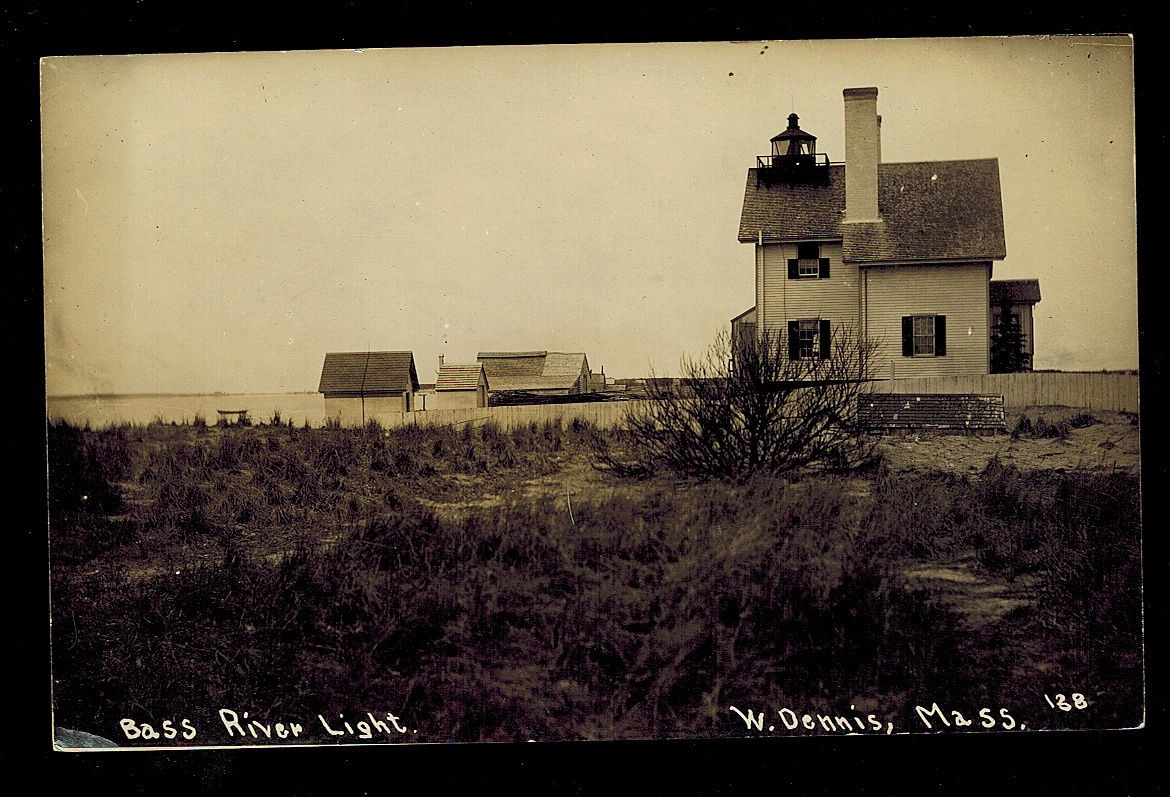
With this telephone line in place, observers at the lighthouse could call the telegraph office and report on conditions offshore.
Identifying specific vessels could be difficult. Some vessels, such as the Bass River based packet schooners David K. Akin, and Annie Louise, or the long-time Nantucket Sound lighthouse/lightship/bouy tender U.S. Verbena, must have been well known by sight. Others, not so much, with identification depending on careful visual inspection of the vessels or any signal letter flags they might be flying. Weather and distance could make this difficult.
In early January, 1882, the lighthouse was unable to report the names of a number of vessels, even though they displayed their signal letters or numbers, because the relevant codebooks were not available. By mid-January, this shortcoming had been addressed. But still, in late January, distance, or poor visibility, prevented reporting many vessel names.
By the end of May, 1882, a good telescope had been installed, through the efforts of the South Dennis telegraph manager, William Baxter. Others who had helped with the scope included Captain Obed Baker 3rd of West Dennis, J.P. Hayward of the Boston Board of Trade, J.L. Baker Esq, of the Boston Tug Boat Association, and John H. Russell, Esq., a ship broker. The telescope was emplaced at the lighthouse for the use of Baxter, and his observer, the lighthouse keeper, Captain Samuel Peak.
Baxter had been the telegraph operator at South Dennis since 1875. Peak had been the lighthouse keeper at the Bishop and Clerks light in 1880 and 1881, and then kept the Bass River light from 1881 to 1906.
Lots of questions. Did Peak's arrival at the light trigger the work to improve vessel identification and communications? The lighthouse had been deactivated through 1880 and early 1881, was this activity part of the reactivation? Who built the telephone line, who paid for it? The original line to West Dennis came from the South Dennis railroad station to T.T. Baxter's store and had been installed by Baxter. Did the line to the lighthouse run from the store as well, or had the phone system developed since the original line was put in? Why did it take so long to get a telescope? How was it paid for?
References: Barnstable Patriot, issues of December 6, 1881, January 10, 1882, January 17, 1882, January 31, 1882, and May 30, 1882. Muse, Ben. 19th Century Telephone Sex. Bass River Notebook, October 2, 2014. Webpage on the Bishops and Clerks lighthouse: Bishop and Clerks, MA examined on November 28, 2015. Webpage on the Bass River lighthouse: Bass River Lighthouse examined on November 28, 2015. Webpage on the Bass River lighthouse: Bass River (West Dennis) MA examined on November 28, 2015. Deyo, History of Barnstable County, 1890. Page 543. Examined at Deyo on November 28, 2015. Reid, Dennis, Cape Cod. 1996.
Leave a Reply