In 1869, two carriage bridges crossed the main stem of Bass River. The lower bridge connected the villages of South Yarmouth and West Dennis where Route 28 crosses the river now; the upper bridge connected South Yarmouth and South Dennis at the current Highbank Bridge. These were both toll bridges built and operated by private corporations created by the state in the early 1830s. They were the only toll bridges on Cape Cod in 1869 (Swift, 1897).
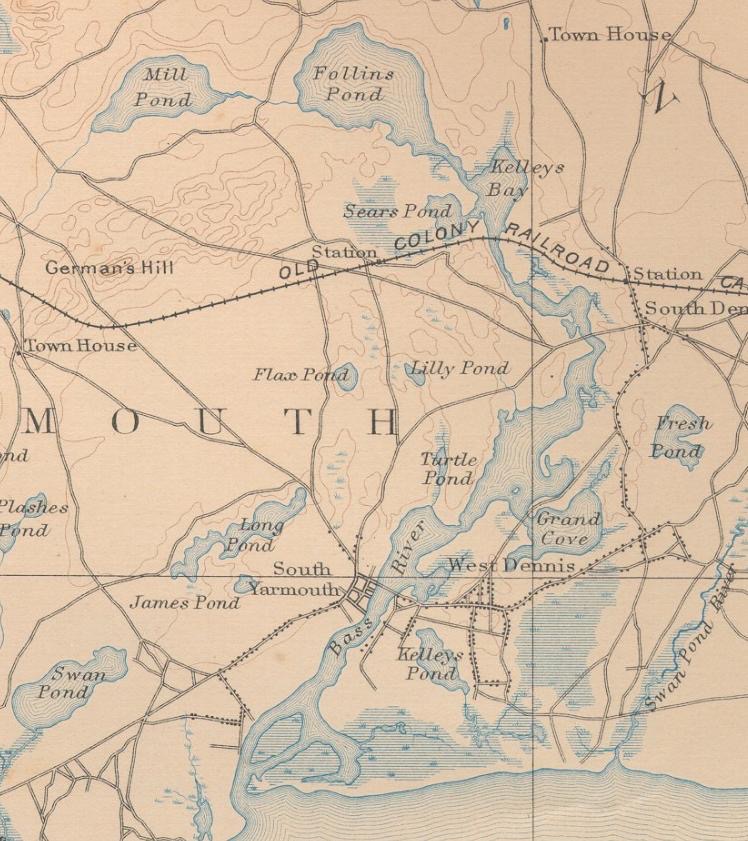
Map of Bass River in 1893, showing location of the bridges. USGS Yarmouth Sheet, 1893.
In 1870, Barnstable County, and the towns of Yarmouth, Dennis, and Harwich, bought out the corporations and took over responsibility for maintaining the bridges.
The shift from private operation of the bridges under state-granted corporate charters to public operation by local government was consistent with broad trends in 19th Century infrastructure finance. From 1790 to the early 1840s, state governments used their power of granting corporate charters, and their own investments, to encourage the construction of roads, canals, railroads, and navigation improvements. After the early 1840s, local governments, exploiting their access to property taxes, became relatively more important in the construction and maintenance of transportation infrastructure. (Wallis, page 62)
This story of the takeover is a work in progress. This blog is a Bass River Notebook, not a polished history, and I’ve felt free to speculate, and to point out what I still don’t know.
The Bridges
The lower bridge, between South Yarmouth and West Dennis, was built and maintained by a company incorporated by the state in 1832. The legislature gave the corporation the right to collect tolls for 70 years and regulated the tolls it could charge in some detail. This bridge replaced a ferry operation a few hundred feet to the south. (Reid)
The original cost of the lower bridge was $4,669.01. The corporation issued 130 shares of stock with a par value of $35. The average aggregate dividend for the 15 years prior to 1869 was $814.67. In 1869, 82 shares were owned by Yarmouth residents, 24 by Dennis residents, and 24 by residents of other places. (Barnstable Patriot, 11-30-1869).
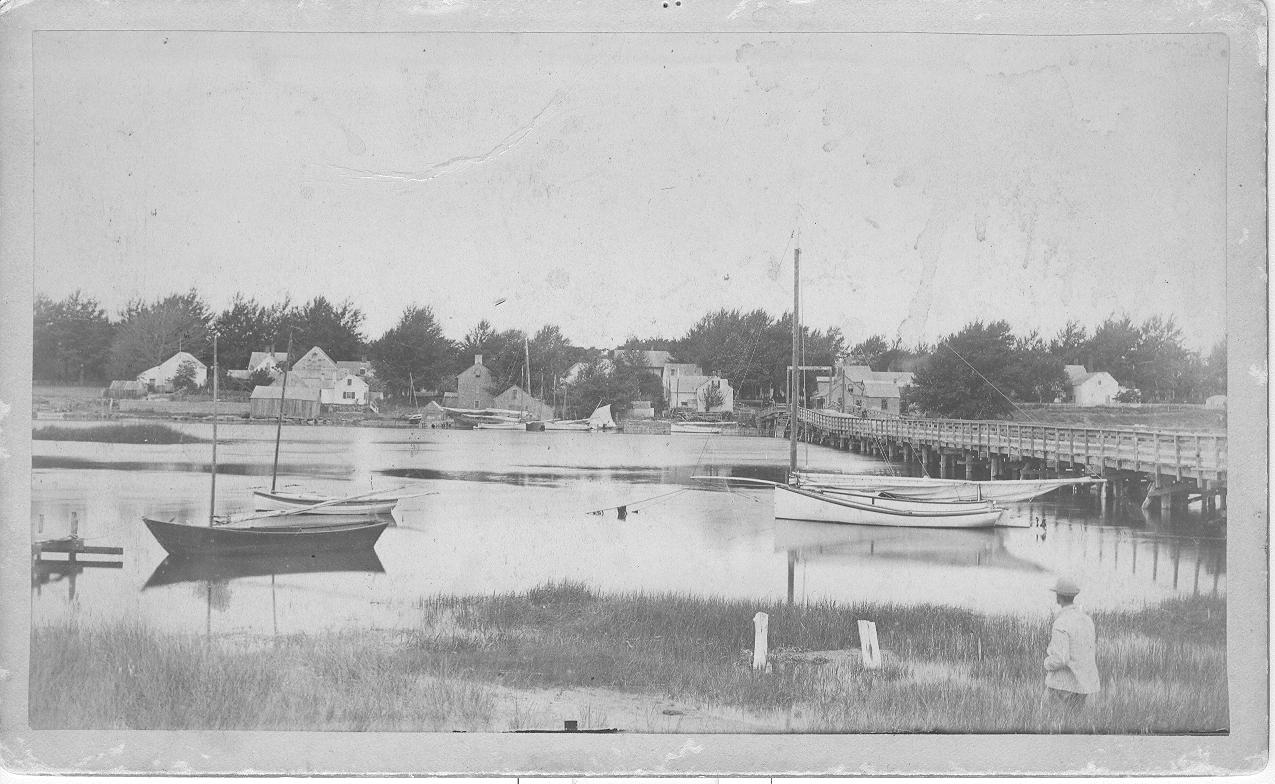
Lower Bridge, prior to 1891. From the collection of the Historical Society of Old Yarmouth; used with permission
The upper bridge, between South Yarmouth and South Dennis, was run by a company incorporated by the state in 1833. This bridge may have replaced a ferry at this spot, and definitely replaced an earlier bridge that was close to today's old railroad bridge abutments; the corporation bought some of the materials from this earlier bridge for use in the new one. (Reid) The act also gave the corporation the right to collect tolls for 70 years, again, regulating these in detail. (Mass. 1833)
This bridge was about 200 feet long and had no drawbridge. The company's books were destroyed by fire in 1851. The upper works of the bridge were substantially renovated, and an abutment was constructed, in 1853 (costing $634); stockholder income had been small; the new railroad, which began to run to South Dennis and beyond, hadn't helped business. (Eliot et al.) This railroad, connecting stations a couple of miles apart in Yarmouth and Dennis, and extending on to Harwich, would have provided an attractive substitute to the road for many purposes; it only took the train a few minutes to get from the South Yarmouth station to the South Dennis station (Farson).
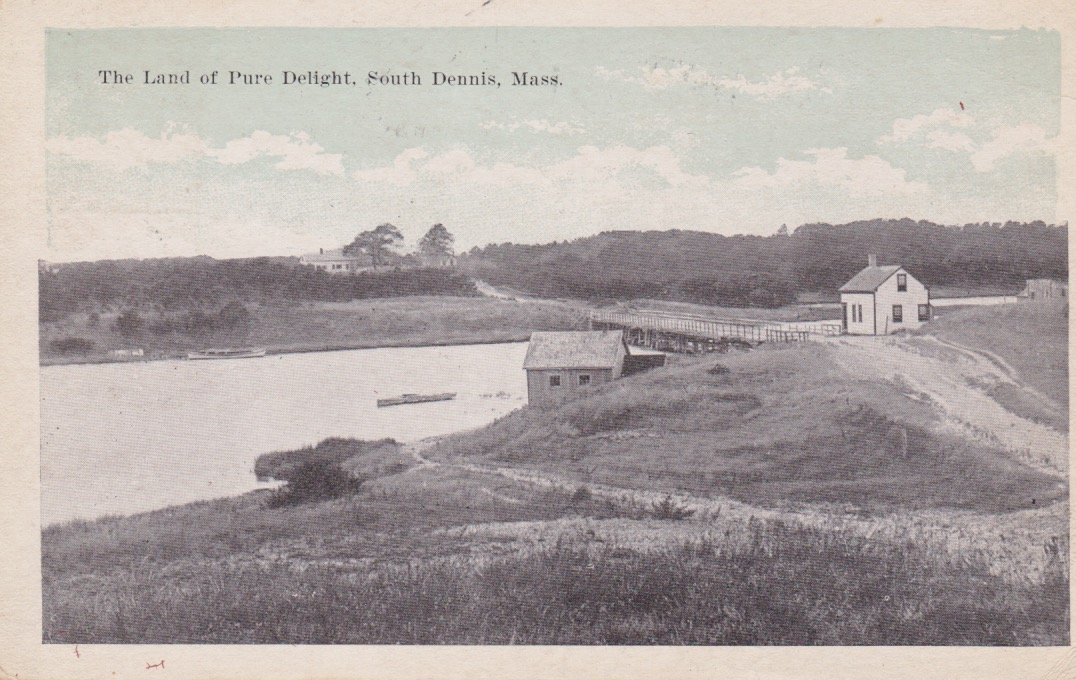
Upper Bridge, in the early 20th Century. This is probably very similar to the bridge that was taken over by the county and towns about 40 years earlier. Ben Muse postcard collection.
The legislature makes it possible
When it was over, an editorial in the Barnstable Patriot gave the credit for the takeover to Russell D. Farris of South Yarmouth (Farris advertised in the paper so this could have affected its assessment). (Patriot, May 10, 1870) Farris was a South Yarmouth entrepreneur and businessman. He was born in 1818 and would have been in his early 50s when the takeover was completed. He’d begun a harness-making business in 1839, selling it after 18 years; in 1857 he’d opened a hardware and general merchandise store. In the years after the public takeover of the bridges he became one of the founders of the Bass River Savings Bank. Farris was also part owner of the schooner Charlotte Brown of Dennis (Dye; Mass, 1873; U.S.).
Farris’s store, in the South Yarmouth business center (now the "Four Corners" area), was close to the intersection of roads running north to the upper bridge, and east to the lower bridge. The lower bridge was just around the corner and about 800 feet away; the upper bridge was about two miles away.
Farris was obviously an energetic man with many business interests. He probably had a combination of business and civic interests in eliminating the bridge tolls. I’d like to get better information about who else may have been involved, and what the arguments for the takeover were.
I can imagine that people might have been annoyed at the cost of the tolls and at the inconvenience of having to pay them. The tolls had been set in the law authorizing the bridges in the early 1830s. For example, at the lower bridge the rates were $0.02 for a foot passenger, $0.06 for a horse and rider, and $0.08 for a horse and wagon or sleigh, $0.06 for 12 sheep or swine, and so on. These might not seem like much, but bear in mind that $0.08 in 1870 is equivalent to $1.50 in 2014, using the consumer price index for adjustment. Other possible comparisons, for example taking into account differences in income between now and then, can make the 1870 cost look even more expensive today. (Officer and Williamson) The need for pocket change appears to have been mitigated at the lower bridge by the use of paper tickets that I assume could be purchased beforehand.
Were there problems with bridge maintenance by the private firms? How were public concerns about the tolls, or private operation of the bridges, expressed in “cracker barrel” debates and public meetings, before being turned into action? Did anyone argue against the takeovers? I don't know yet.
Today we are used to low levels of background price inflation. Prices for goods are generally rising. If one product price remains fixed, the product begins to look relatively cheaper. The late 1860s, however, were years of price deflation: prices were generally declining. If one product price remained fixed, it would begin to look relatively more expensive. The bridge tolls had been fixed in law in the 1830s, and so far as I have been able to find out, the law had not been changed. So, while wages for bridge customers were getting lower, and while prices for the goods sold by merchants, whose delivery wagons were using the bridge, were also getting lower, the bridge tolls remained unchanged. This may have made the bridge tolls seem relatively more onerous (never mind that they would have seemed cheaper during the inflationary war years, not long ago). Maybe this factored into the political pressure to take over the bridges.
In February 1869, the Patriot reported that Farris and others had submitted a petition to the legislature asking for a buyout of the bridge corporations (Barnstable Patriot, February 2, 1869). In Dennis, a bridge agenda item was tacked on to a February 27 town meeting called for another purpose. The Dennis voters chose Joshua C. Howes to look after the town’s interest in the elimination of the tolls. (Barnstable Patriot, March 9, 1869) In Yarmouth, an apparently poorly attended town meeting discussed the issue, voted 67 to 33 in favor of the petition, and chose Heman B. Chase to look after the town’s interest before the legislature. (Yarmouth Register, March 5, 1869)
On March 2, the Patriot identified George Marston as counsel for the petitioners and said that he’d prepared a draft bill to take over the bridges. The bill is quoted at length and is almost the same as the bill finally adopted by the legislature later in the spring. (Barnstable Patriot, March 2, 1869). Marston turns up several times in this story: he is counsel for the petitioners, he drafts the legislation that is ultimately adopted, and he participates in later hearings on behalf of the lower bridge corporation. A Judge Marston also turns up representing the interests of the town of Dennis in certain issues at a later point.
There is a George Marston mentioned in other stories of the period as counsel to local railroad companies (Patriot, February 23, 1869). If this is the same man, he would have been familiar with Massachusetts’s corporate law, rights of way, and so on. A George Marston also turns up as attorney for the county (Yarmouth Register, January 8, 1869). If this is also the same man, he would have been familiar with the mechanics of county government and finance. There was a George Marston who practiced law in Barnstable and Bristol Counties in the mid-nineteenth century. This one served as registrar of probate and judge of probate in Barnstable. In 1859 he was elected district attorney for the southern district, and in 1878 he was elected Attorney General of Massachusetts. (Deyo, Bench and Bar).
Clearly, I need to get my Marstons straight. I don’t know for certain that these are all the same man, or if there are more than one. If there is only one, he represented groups with potentially conflicting interests (the petitioners, one of the bridge corporations, the county, and Dennis) during the period.
The Massachusetts legislature's committee on roads and bridges met in early March to discuss the petitions. The petitioners, the towns of Yarmouth and Dennis, and the Bass River Lower Bridge Association were all represented. The lower bridge representative appears to have opposed the petition at this hearing (“There was no opposition except from the proprietors of the Lower Bridge.”). Representatives of the upper bridge aren’t mentioned. (Barnstable Patriot, 3-9-69)
By April 3, a Bass River toll bridge act had been passed. It provided that the bridges and their abutments and ways would become public highways on acceptance of the award of commissioners to be named by the Supreme Judicial Court. It also provided that, once the bridges were public highways, maintenance would become the direct responsibility of the towns of Yarmouth and Dennis. Yarmouth and Dennis would be reimbursed by Barnstable County and other towns in the county to an extent to be determined by the Commissioners. Yarmouth and Dennis (and Barnstable and potentially other towns) were to be liable for the costs of damages arising from defects in the bridges. (Massachusetts Special Laws).
The longest section of the law explained how the commission would be set up, and how it would operate. The Supreme Judicial Court would appoint three commissioners on application by either of the bridge corporations, or any ten Barnstable County voters. This part of the act thus anticipated that the stockholders of one or both of the bridge corporations might have an interest in being bought out. Following a notice and hearing, the commissioners were to determine the amounts to be paid to the owners of each of the bridges, and to determine how much was to be paid by Barnstable County and by each of the towns in the County. The cost of paying for the bridges was to be divided among the county and towns in proportion to their benefits from the takeover. The commissioners were also to determine the shares of the county and towns in the costs of maintaining the bridges. The recommendations would become binding once accepted by the Supreme Judicial Court. The corporations had the right to appeal to a jury for determination of the appropriate reimbursement, assuming they appealed within 30 days of the commissioners’ report. (Massachusetts Special Laws.)
The Commission
Farris and others submitted a petition by May 10 (Patriot, May 25, 1869). In late June, Judge Ames of the Court appointed a commission that included Thomas D. Eliot and Henry T. Wood of New Bedford, and Alfred Macy of Nantucket (Patriot, June 29, 1869).
Who were these men? There was a congressman Thomas D. Eliot from New Bedford. He was a lawyer and Massachusetts politician, serving in Congress in 1854-55 and from 1859 to March 1869, after which he resumed his law practice. He died in his early 60s on June 14, 1870 (Wikipedia). Macy could have been the Nantucket lawyer, general manager for the Life Association of Massachusetts, and Collector of Customs for the Port of Boston for most of the years from 1861 to 1871, who would subsequently serve on the Massachusetts’ Governor’s Council. (New York Times) Henry T. Wood may have been one of the principals in the lumber firm of Greene & Wood of New Bedford. The firm apparently owned waterfront property at which it accepted deliveries of materials by ship. (New Bedford Board of Trade)
If these are the men, they had backgrounds that would have been useful in their work: two were lawyers, one was a businessman, two clearly had direct experience working with waterfront infrastructure, and two clearly had political connections. None were from the directly affected towns.
Whoever they were, they met in New Bedford on August 5, apparently to organize themselves. A public meeting was scheduled for Wednesday, November 17, at the Barnstable Court House. Only one of the commissioners, Eliot, showed up on the 17th (the day before Thanksgiving) and the hearing was postponed until November 22. (Barnstable Patriot 11-23-69; Eliot et al.)
On Monday, November 22, the commissioners visited the two bridges. (Eliot et al). I like to imagine them meeting at the train station in Barnstable and traveling together to the Yarmouth station. Maybe officers or representatives of the lower bridge corporation met them at the station in buggies and took them to South Yarmouth. After inspecting the bridge, they may have gone up Bridge Street, turned right, passed Farris’s store, and continued two miles to inspect the upper bridge in South Dennis. That evening they could have stayed in rented rooms in South Dennis. An early morning train on Tuesday would get them to Barnstable in time for a hearing on the 23rd. I don’t have any justification for this, and there are many other possibilities.
On Tuesday the 23rd they continued the hearing at the Court House in Barnstable. The commissioners’ report isn’t explicit about who was there besides the three commissioners, but the parties listed as attending on the 17th may have been. On the 17th, George Marston had represented the lower bridge and one M.W. Nickerson had represented the upper bridge. George King had been there for the County of Barnstable, Joseph Day for Yarmouth, Jonathan Higgins for Harwich, Judge Marston for Dennis, and Edward Gardner for the Town of Barnstable. (Eliot et al.) Was anyone else there? Did Russell Farris make it?
The hearing continued “until all the parties who had appeared had been fully heard in proofs and arguments.” (Eliot et al.) The Patriot reported that the hearing in Barnstable took two days; on the 23rd the commissioners heard evidence about the lower bridge, and on Wednesday the 24th, they heard evidence from the county and towns about the distribution of the costs. (Patriot, Nov 30, 1869) At some point, perhaps Tuesday, they must also have heard testimony about the value of the upper bridge.
I don’t know how the commissioners worked to prepare their report. Did they reach their main conclusions in the meeting, or in a private discussion among themselves after the hearing? Did one take the lead in preparing the report, soliciting input and review, from the others? The report must have been distributed in December 1869 or January 1870 because the Register was able to carry the complete text on January 7, 1870.
It's unclear from the report exactly what rule the commissioners used to determine how much to compensate the corporations for the bridges. The legislation said the commission should determine the damages to be paid to the corporations for the laying out of the bridges, the draw on the drawbridge, the bridge abutments, and ways constructed by the corporations (each had been required to construct short roads leading to its bridge). (Mass, 1866-70) This sounds like the corporations were to be compensated for their past investments in the bridges. However, the commissioners described their mission as identifying the “value of the franchise taken under the Act of the Legislature.” (Eliot et al.) This could be compensation for the profits the corporations might have earned if they had continued to operate the bridges. Elsewhere they refer to compensation for the "damages" in the laying out of the infrastructure. (Eliot et al.) This again sounds like compensation for the value of the physical infrastructure.
The corporations would have wanted a sum at least equal to the value of the net income they expected over the remaining lifetimes of their corporate charters (somewhat over 30 years in each case). Of course, this would have been extremely uncertain.
Ultimately, the commissioners chose very different amounts for compensation in the two cases. The lower bridge corporation received $9,285.69 and the upper bridge corporation received $538.25 (only about 6% of the amount of compensation offered for the lower bridge). (Eliot et al.)
The payment for the lower bridge equals the present value of a $674 annual net income through 1902 at a 6.2% interest rate (an estimated real rate of return on equities for the period 1871-1938, see Bernstein). As noted earlier, the commissioners learned that the lower bridge had paid aggregate annual dividends of $814.67 in recent years. So, for the lower bridge, the recent aggregated dividends are not wildly dissimilar from the ad hoc present value calculation based on the Commission compensation. The payment for the upper bridge doesn’t even appear to have been enough to cover the replacement cost of the bridge, since it had cost $634 to renovate just the upper works and abutment of the bridge in the 1850s. The sum paid for the upper bridge implied an annual net income of $39 a year through 1903 using the 6.2% rate of return on equities. That does not seem like a lot of money.
The commission also estimated an appropriate reimbursement for their own costs and the costs incurred by the bridge corporations in the takeover. These came to $642.75 for the proceedings for the lower bridge, and $220.46 for the upper bridge. (Eliot et al.) The sum for the two bridges was $863.21, or about 9% of the assessed value of the two bridges (however, the costs connected with the upper bridge were about 40% of its value). This is a minimal estimate of the costs involved in the takeover. It does not cover the costs incurred to pay Marston for drafting the legislation, the costs of the town meetings, the costs of action by the Massachusetts legislature, or the costs of the Supreme Judicial Court’s involvement.
The cost of the buying out the corporations, and the costs of making the determination, were divided among the county and towns. The statute required a division based on the benefits to each jurisdiction from eliminating the tolls. (Mass, 1866-70) There was some discussion in the hearing about whether the division should be based on the benefits received by towns in their corporate character, or on the benefits received without this limitation. (Eliot et al.) I don't know what the implications of these alternatives were, but the commission decided against limiting its consideration to benefits received by the towns as corporations.
The division of the costs was slightly different for each bridge and are shown in the table below (Eliot et al.) . The Commission also made recommendations about the financing of future repairs and maintenance for the bridges. Yarmouth and Dennis were each expected to maintain the bridges and associated structures within their corporate limits. However the County and Harwich were expected to share the costs with Yarmouth and Dennis. The division of maintenance and repair costs are also shown in the table (Eliot et al.)
|
|
|
County |
Yarmouth |
Dennis |
Harwich |
|
Lower bridge
|
Reimbursement |
7/14 |
3/14 |
3/14 |
1/14 |
|
Maintenance |
2/11 |
4/11 |
4/11 |
1/11 |
|
|
Upper bridge
|
Reimbursement |
8/16 |
3/16 |
3/16 |
2/16 |
|
Maintenance |
4/16 |
5/16 |
5/16 |
2/16 |
The report expressed the distributions in fractions; for quicker interpretation, the following table converts them to approximate percentages:
|
|
|
County |
Yarmouth |
Dennis |
Harwich |
|
Lower bridge
|
Reimbursement |
50% |
21% |
21% |
7% |
|
Maintenance |
18% |
36% |
36% |
9% |
|
|
Upper bridge
|
Reimbursement |
50% |
19% |
19% |
13% |
|
Maintenance |
25% |
31% |
31% |
13% |
Without more information from the record, it’s not clear how the commissioners reached most of these conclusions. They did determine that it had been the practice of the County to pay “the land damages for highways,” which may account for the larger county proportion for reimbursement than maintenance. Yarmouth and Dennis share both the acquisition and maintenance costs equally. Harwich, the next town to the east of Dennis, apparently was thought to benefit proportionately more from the upper than the lower bridge.
What types of repairs and maintenance would have been needed? Normal wear and tear – loose planks and railings, paint, disposal of accumulating manure or snow on the roadbed, rotting wood – would have to be addressed. Winter ice, marine animals, and occasional storm surges could have damaged the bridges. Larger vessels could collide with the lower bridge. The draw on the lower bridge had moving parts – hinges, pulleys, ropes – and these would have worn out and needed replacement. The commissioners don’t say anything about responsibility for the operation of the drawbridge.
The report refers to responsibilities for future repairs and maintenance of the bridges, but not for replacement. Is this significant? Or does it just reflect the nature of the bridges of the time – ongoing maintenance of wooden structures would eventually result in complete replacement of an existing bridge. The report also appears to leave a disconnect between the towns which had direct responsibility for the maintenance and repair of the bridges (Yarmouth and Dennis) and the broader county community which would share responsibility for the costs (Harwich and, indirectly, other towns in the county via the County responsibility). It’s not clear to me how the County and Harwich would have provided input into the maintenance and repair decisions.
In fact, Harwich would be assessed for bridge expenses for another 20 years. Finally, in 1891, when complete replacement of the lower bridge was under consideration, Harwich bolted, and got the legislature to take end their liability. There is little evidence that there was much objection to this from Dennis or Yarmouth by then.
The Supreme Judicial Court accepted the commissioners’ recommendations in early May 1870. (Patriot, May 10, 1870) Apparently neither of the corporations exercised its right for a jury assessment within 30 days.
It would be interesting to have information about how the corporations paid off their debts and the legal expenses associated with dissolution and distributed the remainder to the stockholders. Do any of the corporate records still exist, or were they burnt in someone’s fireplace?
The bridges were now toll-free public ways. The bridges are “henceforth FREE” exulted the Barnstable Patriot, singling Russell Farris out for credit. He “set the ball in motion” and “kept it moving until he had accomplished the freedom of the bridges.” (Patriot, May 10, 1870).
What was gained?
The Patriot would have acknowledged that the bridges were not exactly free. What it meant was that people would no longer have to pay tolls to cross them. But the bridges themselves still had to be maintained, and would need to be replaced at intervals. These costs now fell on the taxpayers of the towns and county rather on the people actually using the bridges. The costs had been shifted from one group of people to another.
This raises three general, and maybe unanswerable, questions: (1) were the residents of the towns better off; (2) did the gains exceed the costs of the takeover; (3) how were the gains and losses distributed among the different groups in the affected communities?
Were the residents of the towns better off after the takeovers? That would depend on how the costs of operating the bridges changed. The costs of operating the toll bridges must have included: (a) the time it took for the directors to manage the business; (2) the costs of maintaining and replacing the bridges; (3) the costs of collecting the tolls; (4) the inconvenience of paying tolls and the loss of some beneficial traffic due to the cost of the tolls.
After the takeover, the bridges would be managed by county commissioners, town meetings, selectmen, and special committees. This would have involved more people, more organizations, and more coordination between organizations, than a simple private board of directors. I don’t see any savings here, and maybe an increase in costs.
As noted earlier, the bridges would have required maintenance and repair, and periodic upgrades and replacement. But it is difficult to see any savings here. If the abolition of tolls meant more traffic, costs might have increased. The lower bridge had a drawbridge to allow larger vessels to get into the river above the bridge. I don’t know how this was operated, either before, or after, the takeover. I assume that toll keeper would help open and close it before. If so, was this now left solely to the crews of vessels using the drawbridge? Did the town contract with nearby business owners to help with the drawbridge when necessary? On balance, I don’t see an increase in costs of operating the draw since these would depend on vessel traffic, and there is no reason to believe the takeover would have changed that.
Once the towns and county had taken over there was no more need for a toll collector, and the tollhouses on each bridge could be converted to other uses. The lower bridge, at least, sold tickets that could be used to pay the tolls. The costs of these would be eliminated. So here we have a clear savings in labor and material.
There was no longer any charge to cross the bridges. The reduced cost and increased convenience should have increased the use of the bridge. People may have taken valuable trips they otherwise would have skipped. If there was increased use, this would have fed back into costs for repairs and maintenance.
The second general question was whether or not the gains from the takeover exceeded its benefits. To the extent that there were net benefits from the takeover, they would have come at the cost of the time spent on the political and administrative costs of taking over the bridges. Time was invested in carrying around petitions; Yarmouth apparently held a town meeting just for this issue, Dennis tacked a discussion of it onto a meeting called for another purpose. George Marston, an eminent local attorney, invested time in drafting the bill. Lobbyists worked with legislators, the legislature held a public hearing and took action. Lobbyists would have worked with the Supreme Judicial Court and its commission. The commission itself cost about $860. The corporations may have incurred costs to close out their businesses.
Finally, the third general question was who gained and who lost from the action. The various parties who might gain or lose from the change included: (1) bridge stockholders; (2) bridge users; (3) and Cape taxpayers, particularly those in Dennis and Yarmouth.
The corporations would no longer pay dividends to stockholders, but these did receive some compensation from the county and towns. There is no way to know if this compensation was more than or less than the value of the future dividends, although the fact that the bridge corporations didn’t protest the compensation package, as they might have, suggests that they weren’t significantly underpaid.
The direct bridge users are clear gainers. They would no longer have to pay tolls with associated inconvenience of carrying the appropriate change or tickets. No more inconvenience if they needed to cross late at night and the toll keeper had gone to bed. It seems plausible that these users were found mainly among the residents of the villages along the Nantucket Sound shore between Hyannis and Chatham, and that tmost of these accrued to residents of Yarmouth and Dennis.
There are indirect users as well – an increase in traffic may have benefitted some business owners. If the bridge increased traffic in certain business districts, it may have increased business profitability for a while. However, increased profitability may have attracted new competitors, which would have driven profits back down, at least somewhat. Any increase in traffic may also have involved a shift in business from other firms, imposing a cost on them. People who owned the land near routes that saw more traffic would have seen an increase in their property values as businesses bid for good locations. Oddly, future property owners wouldn’t have enjoyed this benefit: they would have had to pay the original landowners more for the property because of its increased value.
The cost of the bridges would be transferred to county taxpayers, and particularly to those in Dennis, Yarmouth, and to some extent in Harwich. The key revenue source for these towns at the time was the property tax (and, while I need to confirm this, I think the county would also have been indirectly dependent on the property tax because of revenues it collected from the towns). Probably the property owners along the Cape Cod Bay shores in Dennis and Yarmouth were net losers from the takeover. They would have contributed their property taxes to the towns, but are likely to have had limited interest in these bridges. (When a drawbridge between West Dennis and South Dennis was destroyed in a storm in 1905, the town meeting could never be brought to rebuild it, due to disinterest among north side voters (Reid)). The action would also have reduced the property tax base in the towns. I’ve noticed that Dennis shareholders in the lower bridge were assessed property taxes on the par value of their shares.
It doesn’t appear that town or county voters were ever formally involved in the decisions to buy out the corporations and take over the bridges. The legislature created a process, and the Supreme Judicial Court made a decision based on the recommendations of its commission. If the corporations had protested, they had a right to a jury assessment of their reimbursement. The towns and county didn’t have a similar right.
As I mentioned at the start, the shift from private operation of the bridges under state-granted corporate charters to local government operation was consistent with broad trends in 19th Century infrastructure development. In this case, the shift in responsibility from the state to local governments was initiated by the local residents rather than the state. The state funding was not an issue. The new local responsibilities would be paid for out of property taxes. Further research on this topic should include looking at other state statutes from the period to see if there was a pattern of buyouts of bridge corporations, and a look at trends in the efficiency and efficacy of Massachusetts local property tax collection.
Thanks
Burt Derick of the Dennis Historical Society, Maureen Rukstalis and Duncan Oliver of the Historical Society of Old Yarmouth, and Meg Hall and a librarian at the Barnstable County Law Library have helped with documents and made suggestions about other sources. I’ve used the Sturgis Library’s on-line, searchable, files of the Barnstable Patriot and the Yarmouthport Library’s Yarmouth Register microfiche. Jeff Hartman of Juneau and I have talked over some of this. Jeannine S. Missaoui has shared some information about Russell Farris and his family. David Kew's web page on Cape Cod history has been very helpful. All the errors here are mine.
Sources
Barnstable Patriot. 1869. Personal. February 2, 1869. Sturgis Library Digital Archive. Accessed on April 10, 2009.
Barnstable Patriot. 1869. To the County Commissioners for the County of Barnstable. February 23, 1869. Sturgis Library Digital Archive. Accessed April 10, 2009.
Barnstable Patriot. 1869. The Bridges over Bass River. March 2, 1869. Sturgis Library Digital Archive. Accessed on April 10, 2009.
Barnstable Patriot. 1869. Bass River Bridge Hearing. March 9, 1869. Sturgis Library Digital Archive. Accessed on March 23, 2009.
Barnstable Patriot. 1869. Town Meetings. March 9, 1869. Sturgis Library Digital Archive. Accessed on April 10, 2009.
Barnstable Patriot. 1869. Commonwealth of Massachusetts. May 25, 1869. Sturgis Library Digital Archive. Accessed on March 23, 2009.
Barnstable Patriot. 1869. The Bass River Bridges. June 29, 1869. Sturgis Library Digital Archive. Accessed on March 23, 1869.
Barnstable Patriot. 1869. Bass River Bridges. November 23, 1869. Sturgis Library Digital Archive. Accessed on March 23, 2009.
Barnstable Patriot. 1869. Bass River Bridges, — The Hearing. November 30, 1869. Sturgis Library Digital Archive Accessed on March 23, 2009.
Barnstable Patriot. 1870. Bass River Bridges Free. May 10, 1870. Sturgis Library Digital Archive. Accessed on March 23, 2009.
Bernstein, Peter L. 1997. What Rate of Return Can You Reasonably Expect… or What Can the Long Run Tell Us about the Short Run? Financial Analysts Journal. March/April. Accessed at https://umdrive.memphis.edu/cjiang/www/teaching/fir7410/Readings/bernstein.pdf, on April 9, 2009.
Dennis Historical Society. Photo archives.
Deyo, Simeon L. 1890. History of Barnstable County, Massachusetts. Chapter XVII. Town of Yarmouth. New York. H.W. Blake & Co. Accessed on the Internet at http://capecodhistory.us/Deyo/Yarmouth.html on April 4, 2009.
Deyo, Simeon L. 1890. History of Barnstable County, Massachusetts. Chapter 10. Bench and Bar. New York. H.W. Blake & Co. Accessed on the Internet at http://capecodhistory.us/Deyo/lawyers.html on July 7, 2009.
Eliot, Thomas D., Alfred Macy, and Henry T. Wood. 1870. Bass River Bridges. Award of the Commissioners. Yarmouth Register. January 7, 1870.
Farson, Robert H. 1993. Cape Cod Railroads. Including Martha’s Vineyard and Nantucket. Cape Cod Historical Publications. Yarmouthport, MA.
Historical Society of Old Yarmouth. Society web site.
Historical Society of Old Yarmouth. 2003. Images in Time. Cape Cod Views From the Historical Society of Old Yarmouth. Yarmouthport, MA.
Massachusetts, Commonwealth of. 1833. Acts and Resolves Passed by the General Court.
Massachusetts, Commonwealth of. Massachusetts Special Laws. 12. 1866-1870.
Massachusetts, Commonwealth of. 1873. Journal of the House of Representatives of the Commonwealth of Massachusetts For the Year 1873 and For the Extra Session of 1872. Wright & Potter, State Printers. Boston. Accessed on the Internet at http://books.google.com/books?id=p1MOAAAAYAAJ&pg=RA1-PA46&lpg=RA1-PA46&dq=%22Russell+D.+Farris%22&source=bl&ots=i50L7SOvNF&sig=erB7BvI9491PoCiUe3eYSCb1ol0&hl=en&ei=s-_LSZiSHduMtgf5yYzPCQ&sa=X&oi=book_result&resnum=1&ct=result#PPP9,M1 on April 4, 2009.
New Bedford Board of Trade, Zephaniah Walter Pease, George A. Hough, William Lawton Sayer. 1889. New Bedford, Massachusetts: its history, industries, institutions and attractions. Mercury publishing company, printers, 1889. Accessed at http://books.google.com/books?id=ZSIWAAAAYAAJ on April 6, 2009. (page 264).
New York Times. 1874. Hon. Alfred Macy. Obituary, December 25, 1874. Accessed at http://query.nytimes.com/gst/abstract.html?res=9A04E5D81331E03ABC4D51DFB467838F669FDE on April 6, 2009.
Officer, Lawrence H. and Samuel H. Williamson. MeasuringWorth.com. Accessed at http://www.measuringworth.com/uscompare/relativevalue.php on October 5, 2015.
Reid, Nancy Thatcher. 1996. Dennis, Cape Cod. Dennis Historical Society.
Swift. Charles Francis. 1884. History of Old Yarmouth: Comprising the Present Towns of Yarmouth and Dennis : from the Settlement to the Division in 1794, with the History of Both Towns to These Times. Published by the author. Accessed at http://books.google.com/books?id=eq1qzgjQqqkC&pg=PA117&lpg=PA117&dq=Swift+and+%22Bass+River%22&source=bl&ots=343C5xO9ub&sig=SlsMemBdkgiJtA7MSC6zOe3RCtg&hl=en&ei=pXPbSb6eD5aYMsXC4KkI&sa=X&oi=book_result&ct=result&resnum=1#PPA266,M1 on April 7, 2009.
Swift, Charles Francis. 1897. Cape Cod. The Right Arm of Massachusetts. An Historical Narrative. Register Publishing Company. Yarmouth. Accessed at http://books.google.com/books?id=YLANnkUD6O4C&dq=Cape+Cod+The+Right+Arm&printsec=frontcover&source=bl&ots=hmCXwjuOdo&sig=009FmalWR8aurYaCXi3oqmczrgo&hl=en&ei=NqfeSfH0C5rEtAOPktWxCQ&sa=X&oi=book_result&ct=result&resnum=2 on April 9, 2009.
United States. Customs District VII. Barnstable Ship Register 1814-1913.
Wallis, John Joseph. 2000. American Government Finance in the Long Run: 1790 to 1990. Journal of Economic Perspectives. 14(1): 61-82. Winter.
Wikipedia. Thomas D. Eliot. Last updated October 27, 2008. Accessed at http://en.wikipedia.org/wiki/Thomas_D._Eliot on April 6, 2009.
Yarmouth Register, January 8, 1869.
Yarmouth Register, February 5, 1869.
Yarmouth Register, March 5, 1869.
Yarmouth Register, January 7, 1870.
Leave a Reply